What is the Commonwealth Scholarship?
The Commonwealth Scholarship programme funds students from developing Commonwealth countries to take a Master's or PhD at a UK university. The UK Foreign, Commonwealth & Development Office provides the money, and the Commonwealth Scholarship Commission runs the awards. PhD scholarships support research that addresses development needs in Commonwealth countries.
This is not one single scholarship but a family of awards. There are Master's and PhD scholarships, Shared Scholarships hosted jointly with UK universities, Distance Learning Scholarships for part-time online study, and a set of university-run awards. Our guide to Top 10 Commonwealth Scholarships for Commonwealth Countries explains how the Commonwealth Scholarship and Fellowship Plan works: member countries offer awards to citizens of other member countries.
The practical point is that each strand has its own eligibility list, its own deadline and its own application route. Read the strand that matches your level and country before you prepare anything.
Commonwealth Scholarship at a glance
| Item | Detail |
|---|---|
| Funder | UK Foreign, Commonwealth & Development Office (FCDO) |
| Administrator | Commonwealth Scholarship Commission (CSC) |
| Levels | Master's degree or PhD |
| Study destination | United Kingdom |
| Applications open | 8 September 2026 |
| Deadline | 20 October 2026, 16:00 BST (15:00 GMT) |
| Course start | September 2027 |
| What is covered | Airfare, tuition and examination fees, monthly stipend, study travel grant, warm clothing allowance, among others |
| Stipend rate | £1,378 per month, or £1,690 per month at universities in the London metropolitan area |
| Number of awards | Not specified in the listing |
The stipend figures are quoted at current rates on the listing, so confirm the live numbers on the official CSC page before you budget.
Open scholarships that match
 Fully funded
 Singapore
Commonwealth Scholarship at the National University of Singapore (NUS)
National University of Singapore
 United Kingdom
Commonwealth Online Global Health Scholarships at University of Edinburgh
University of Edinburgh
Commonwealth Distance Learning Scholarships for Developing Commonwealth Countries
 United Kingdom
Developing Solutions Scholarships at University of Nottingham for Master's Study
University of Nottingham
 Australia
n Government Research Training Program (RTP) Scholarships at the University of Adelaide
University of Adelaide
 Fully funded
Australia
University of Newcastle Postgraduate Research Scholarships in Australia
University of Newcastle
 Fully funded
United Kingdom
Chevening Scholarships in the UK for International Master's Students
British Government/FCO
 Fully funded
United Kingdom
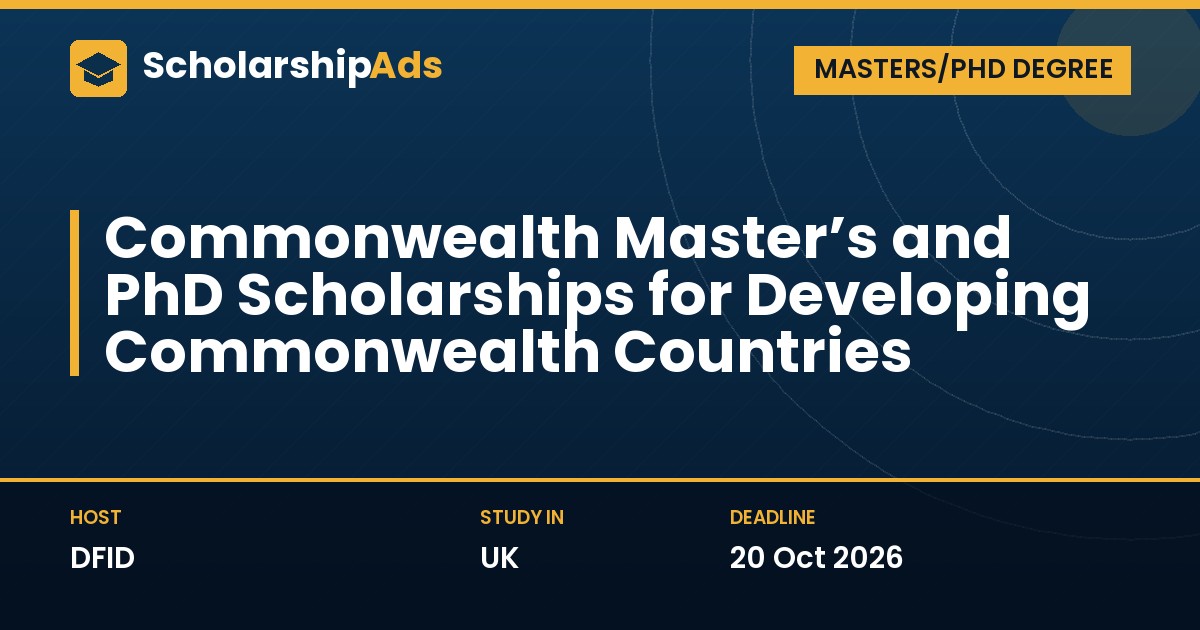
Commonwealth Master's and PhD Scholarships for Developing Commonwealth Countries (DFID)
DFID
 Fully funded
United Kingdom
Rhodes Scholarships at Oxford University for International Students
Rhodes Scholarship Fund
 Australia
Research Training Program (RTP) Scholarships, Australian Government
Australian Government
 Fully funded
United Kingdom
Commonwealth Shared Scholarship Scheme at UK Universities
DFID/UK Universities
Which Commonwealth Scholarship strands exist?
Four strands matter most to applicants searching for a Commonwealth Scholarship in the UK, plus a set of university-specific awards.
Commonwealth Master's and PhD Scholarships
The main UK route, covered by Commonwealth Master’s and PhD Scholarships for Developing Commonwealth Countries. It funds Master's or PhD study at UK universities, with airfare, tuition and examination fees, a stipend, a study travel grant and a warm clothing allowance among the benefits. The current round closes on 20 October 2026 at 16:00 BST (15:00 GMT).
Commonwealth Shared Scholarships
The Commonwealth Shared Scholarship Scheme at UK Universities is jointly supported by participating UK universities and aimed at candidates from least developed and lower middle income Commonwealth countries. It pays approved tuition and examination fees, airfare, a monthly stipend, a warm clothing allowance, a thesis grant, a study travel grant and an excess baggage allowance. The awards are usually tenable for one year only, and the current deadline is 9 December 2025 at 16:00 GMT for courses starting September 2026.
Commonwealth Distance Learning Scholarships
The Commonwealth Distance Learning Scholarships for Developing Commonwealth Countries pay tuition fees and study grants for part-time Master's study by distance learning on selected courses from UK universities. You keep living and working at home. The current deadline is 31 March 2026 at 16:00 GMT.
University-run Commonwealth awards
Several universities run their own awards for Commonwealth students. The Queen Elizabeth Commonwealth Scholarships, run by the Association of Commonwealth Universities, fund a two-year Master's in a low or middle income Commonwealth country other than your own, with tuition, a living stipend, return economy flights, an arrival allowance and a research support grant. The official site has the current round.
The Commonwealth Scholarship at the National University of Singapore (NUS) covers full tuition plus a monthly stipend for research Master's and PhD students. The Commonwealth Scholarship for Integrative Sciences and Engineering at NUS Graduate School funds a PhD in that field. The Commonwealth Online Global Health Scholarships at University of Edinburgh supported online Master's study in global health. For all three, the official site has the current round.
Who qualifies for a Commonwealth Scholarship?
Eligibility is set per strand, but the Master's and PhD route has a clear core. You must meet every condition, not most of them.
- Be a citizen of, or have been granted refugee status by, an eligible Commonwealth country, or be a British Protected Person.
- Be permanently resident in an eligible Commonwealth country.
- Be available to start your studies in the UK by the start of the UK academic year in September 2027.
- By September 2027, hold a first degree of at least upper second class (2:1) honours standard, or a lower second class degree plus a relevant postgraduate qualification, usually a Master's degree.
- Be unable to afford to study in the UK without the scholarship.
- Have provided all supporting documentation in the required format.
Which countries are on the list?
The Master's list includes Bangladesh, Belize, Botswana, Cameroon, Dominica, Eswatini, Fiji, Gabon, Ghana, Grenada, Guyana, India, Jamaica, Kenya, Kiribati, Lesotho, Malawi, Malaysia, Maldives, Mauritius, Montserrat, Mozambique, Namibia, Nauru, Nigeria, Pakistan, Papua New Guinea, Rwanda, Saint Helena, Saint Lucia, Saint Vincent and The Grenadines, Samoa, Sierra Leone, Solomon Islands, South Africa, Sri Lanka, Tanzania, The Gambia, Togo, Tonga, Tuvalu, Uganda, Vanuatu and Zambia.
The PhD list is shorter and includes Bangladesh, Cameroon, The Gambia, Kenya, Kiribati, Lesotho, Malawi, Mozambique, Nigeria, Pakistan, Rwanda, Sierra Leone, Solomon Islands, Sri Lanka, Tanzania, Togo, Tuvalu, Uganda and Zambia. If your country appears on one list and not the other, apply at the level that fits.
One UK Master's is usually the limit
The CSC would not normally fund a second UK Master's degree. If you are applying for a second one, you need to justify why you want to do it. Plan your answers around that question rather than around the funding itself.
What does the scholarship pay?
The Master's and PhD award is broad. Each scholarship provides airfare to and from the United Kingdom, tuition and examination fees, a monthly stipend, a study travel grant, a warm clothing allowance and other items. The stipend is £1,378 per month, or £1,690 per month for those at universities in the London metropolitan area.
The Shared Scholarship pays a similar package: approved tuition and examination fees, approved airfare from your home country to the UK and return at the end of your award, a monthly stipend at the same rates, a warm clothing allowance, a thesis grant, a study travel grant and an excess baggage allowance. It is usually tenable for one year only.
The Distance Learning award is narrower: tuition fees plus study grants where they are required. That reflects the format. You are not relocating, so there is no airfare and no stipend for living costs.
None of these awards is a cash prize. The fees go to the university, and the stipend is paid to you in instalments to cover living costs. Work out your own monthly budget against the rate for your city before you accept a place.
Deadlines and timeline for 2026
| Strand | Applications open | Deadline | Course start |
|---|---|---|---|
| Master's and PhD Scholarships | 8 September 2026 | 20 October 2026, 16:00 BST (15:00 GMT) | September 2027 |
| Shared Scholarships | Check the official page | 9 December 2025, 16:00 GMT | September 2026 |
| Distance Learning Scholarships | Check the official page | 31 March 2026, 16:00 GMT | September 2026 |
Two things trip people up. First, each nominating body sets its own closing date, which is often earlier than the CSC deadline, so the real cut-off for you may be weeks before the date above. Second, each university has its own closing date for admissions, and you need an offer as well as a scholarship.
Work backwards. Start with your nominating body's date, then the university's admissions date, then the CSC deadline. Whichever comes first sets your personal timeline.
How to apply for a Commonwealth Scholarship, step by step
- Confirm your country is on the list. Check the Master's or PhD list for the current round and note whether your country appears on both.
- Find your nominating body. The CSC does not accept direct applications. The main route is a national nominating agency; selected non-governmental organisations and charitable bodies also nominate. For PhDs, selected universities and university bodies can nominate their own academic staff.
- Ask the nominating body for its rules. Each body runs its own selection process, sets its own eligibility criteria and has its own closing date. Get these in writing before you write anything.
- Choose an eligible course and university. Confirm the course is on the eligible list and check the university's admission requirements and English language rules.
- Apply to the university separately. The scholarship application does not replace the admissions application. Send both.
- Submit the CSC application through the Electronic Application System (EAS). This is required in addition to any form your nominating body asks for.
- Meet the deadline. All applications must be submitted by 20 October 2026, 16:00 BST (15:00 GMT) at the latest. Keep copies of everything you submit.
For the Shared Scholarship the route is different: you apply to an eligible Master's course at a participating UK university and also submit an application through the CSC's online application system. For Distance Learning, you get admitted to an approved course and then apply through the EAS.
Documents you need to prepare
Most rejections at the documentation stage are avoidable. Gather these early, in the format the CSC and your nominating body ask for.
- Degree certificates and full academic transcripts, showing your honours classification.
- Proof of citizenship, or refugee status documentation, plus evidence of permanent residence in an eligible country.
- Passport or national ID.
- References from people who can speak to your academic work and your development plans.
- An English language test result if your university requires one.
- A clear statement of how your studies connect to development needs in your home country.
- Any nominating body forms, which may ask different questions from the CSC form.
Transcripts and references take the longest. Request them before applications open on 8 September 2026, not after.
How selection works
There are two filters, and you have to pass both. Your nominating body runs its own selection process first, using its own criteria and its own closing date. Only nominees go forward. The CSC then considers nominees against the scholarship's aims, including academic merit and the development relevance of the proposed study.
That is why the statement matters so much. A strong transcript gets you considered. A clear account of what you will do with the degree, and why it matters where you come from, is what separates nominees. The PhD strand is explicit that it supports research addressing development needs in Commonwealth countries.
The number of awards is not specified in our listings, so treat any figure you see elsewhere as unverified. The official CSC page carries the current information.
Who it suits and who should look elsewhere
This suits you if you are a citizen of an eligible Commonwealth country, permanently resident there, hold a 2:1 or better, and cannot pay for UK study yourself. It fits candidates who can work with two institutions at once, a nominating body and a university, and who can explain the link between the degree and development at home.
Look elsewhere if your country is not on the relevant list, you already hold a UK Master's and cannot justify a second, or you want to start within a few months. The cycle runs a year ahead: applications in late 2026 are for courses starting September 2027.
If you need to keep working, the Commonwealth Distance Learning Scholarships for Developing Commonwealth Countries fit better than a residential UK award. If you want to study in a Commonwealth country other than the UK, the Queen Elizabeth Commonwealth Scholarships are the closer match. Research students who want a short visit abroad rather than a full degree should read the ARSA Travel Scholarships for Commonwealth Citizens, a grant-in-aid for a six to twelve month research visit to Australia; the official site has the current round.
Students who want a full-tuition award in the Caribbean should look at the SGU Commonwealth Jubilee Scholarship Program at St. George's University in Grenada, which offers 60 full-tuition scholarships to Commonwealth citizens. It covers tuition only, so you still need a plan for living and travel costs.
Common mistakes to avoid
- Applying straight to the CSC. Direct applications are not accepted. Without a nominating body, your file does not move.
- Missing the nominating body's earlier deadline. The CSC date is the outer limit, not your personal one.
- Skipping the university application. You need admission as well as funding, and the university has its own closing date.
- Assuming both lists match. The Master's and PhD country lists differ. Check the one for your level.
- Submitting documents in the wrong format. Incomplete or badly formatted files are a stated reason for rejection.
- Reusing a generic statement. Selection weighs development relevance, so a statement written for another scholarship reads as one.
- Ignoring the second UK Master's rule. If this applies to you, address it head on in your application.
Alternatives and related awards
If the Commonwealth Scholarship does not fit, several related routes use the same countries and similar documents. The Commonwealth Shared Scholarship Scheme at UK Universities has a later deadline and a shorter award, usually one year. The Commonwealth Distance Learning Scholarships for Developing Commonwealth Countries let you study part-time from home.
Beyond the Commonwealth family, browse our Scholarships in United Kingdom page, or check Scholarships in Singapore if the NUS awards interest you. Subject-specific funding is listed under Development Studies Scholarships, Health Scholarships and Science and Technology Scholarships. Our Scholarship tips section covers statements and references, and All guides lists every country and programme guide we publish.
For current openings across every strand, use the filtered list for this page.
 South Africa