
What is the Fulbright Foreign Student Program?
The Fulbright Foreign Student Program is the route for international students who want to do graduate study or research in the United States. The U.S. government runs it together with binational commissions and embassies. It is not the same as the Fulbright U.S. Student Program, which sends U.S. citizens abroad.
The award pays for graduate-level study and research. In general the grant funds tuition, airfare, a living stipend and health insurance, and the Fulbright program provides funding for the duration of the study. Award benefits also include J-1 visa sponsorship, funding support, a health benefit plan and enrichment activities. The official page and your country page carry the complete list of benefits.
So what is a Fulbright scholarship in practice? It is a government-funded exchange grant, and the exact terms differ from country to country. That is why the first thing to check is always your own country's Fulbright office, not a generic page.
Fulbright scholarships for international students: the two listings we track
We keep two current listings that cover this programme from different angles. Read the one that matches your situation.
| Listing | Who it is for | Level | Deadline |
|---|---|---|---|
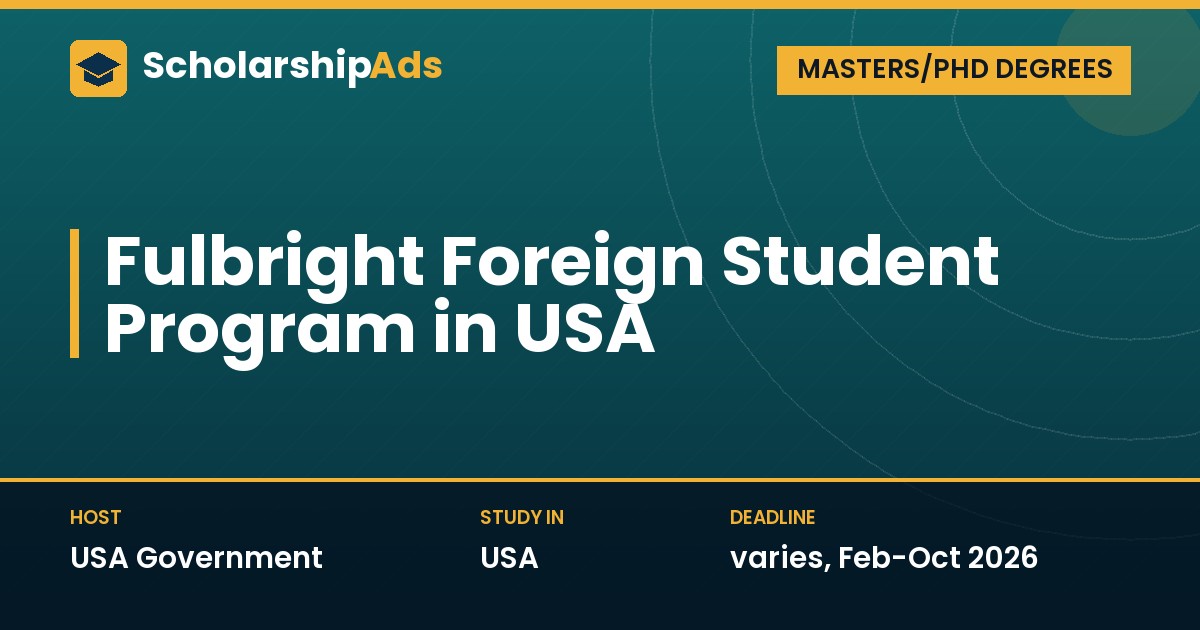
| Fulbright Foreign Student Program in USA | International students from more than 160 countries | Masters/PhD degrees | Varies, Feb-Oct 2026 |
| Fulbright US Student Program for Study Abroad | U.S. citizens and nationals | Study abroad programs | Varies by country |
The first listing is the one most readers of this page need. It covers study in the USA at graduate level, with a course start in academic year 2027. The second listing is the mirror programme: it sends U.S. citizens and nationals abroad and requires U.S. citizenship at the time of the application deadline. Permanent residents are not eligible for that one.
Both listings are updated as new rounds open. To see everything currently open, use our filtered list for this page.
Open scholarships that match
 United States
Global Undergraduate Exchange Program (Global UGRAD): US Exchange Semester
US Department of State ECA/Word Learning
 United States
Global Leaders Fellowship at George Washington University (GW)
George Washington University
 Fully funded
United States
Fulbright Foreign Student Program in the USA for International Graduate Students
USA Government
 Fully funded
United States
Hubert Humphrey Fellowships in USA for International Students
USA Government
 Canada
 Australia
Fulbright Foreign Student Program: Study, Research or Teach Abroad
USA Government
What the Fulbright scholarship pays for
The Foreign Student Program grant generally covers tuition, airfare, a living stipend and health insurance. The Fulbright program provides funding for the duration of the study. Award benefits include J-1 visa sponsorship, funding support, a health benefit plan and enrichment activities.
Amounts are set by your country's Fulbright office and by the U.S. institution, so no single figure applies to every grantee. Your country page and the official website carry the current figures for your award. Treat any number you see on a forum as unverified until you find it on the official site.
What is not covered by the general description
The general listing does not promise a fixed monthly amount, a book allowance or a travel grant for dependents. If those matter to your budget, ask your country office directly before you apply.
Who qualifies for the Fulbright Foreign Student Program
Eligibility and selection procedures vary widely by country. The general requirements below apply everywhere, and your country adds its own rules on top.
- Reside in the country of nomination at the time of application.
- At the time of program start date, possess the equivalent of a U.S. bachelor's degree with a good academic record.
- Be fluent in English, shown by a recommended recent score of no less than 550 on Paper Based TOEFL, 79-80 on Internet Based TOEFL (IBT), or 6.5 overall on IELTS. Test scores can be sent to IIE by entering institutional code 2326 on the day of the test.
- Do not hold U.S. citizenship. Dual citizens are not eligible for program participation.
Additional eligibility requirements differ by country of citizenship. Check your country page before you spend time on the application.
Fields of study
Fulbright encourages applications from all fields, including interdisciplinary ones. Students cannot apply for programs with clinical requirements such as dentistry, medicine, pharmacy or nursing. Fields such as public health and nursing administration are permitted.
Fulbright application requirements and documents
The application is submitted online through your country's Fulbright Commission or U.S. Embassy. The core documents are the same in most countries, though each office adds its own.
- Online application form for your country's competition
- Academic transcripts and degree certificates showing the equivalent of a U.S. bachelor's degree
- English test scores: TOEFL or IELTS at the recommended level above
- Study or research objective, which is where the Fulbright personal statement does its work
- Letters of recommendation, as required by your country office
- Passport or identity documents, and any country-specific forms
The Fulbright personal statement is the part applicants most often rush. It has to connect your past work, your proposed U.S. study and what you will do when you return. Write it for your country's readers, not for a generic audience, and give your referees time to read it.
When are Fulbright applications due?
Deadlines vary per country but fall around February to October annually. There is no single global closing date, and the U.S. embassy in one country may close months before the commission in another.
Our listing for the Fulbright Foreign Student Program in USA carries the deadline as varying, February to October 2026, with courses starting in academic year 2027. That spread is why you should find your country page first and put its date in your calendar before anything else.
How to read the timeline
Work backwards from your country's deadline. Allow time for English tests, transcripts, referee requests and several drafts of the personal statement. If your country runs an interview stage, expect it after the written deadline, not before.
How to apply step by step
- Find your country on the official Fulbright website and open its Foreign Student Program page. Note the deadline and any country-specific rules.
- Confirm you meet the general requirements: residence in the country of nomination, the equivalent of a U.S. bachelor's degree, English fluency and no U.S. citizenship.
- Check that your field is allowed. Clinical programs such as dentistry, medicine, pharmacy and nursing are excluded.
- Book your TOEFL or IELTS test early, and use institutional code 2326 if you want scores sent to IIE.
- Draft your study or research objective and your Fulbright personal statement, then revise them against your country's guidance.
- Request transcripts and recommendation letters well before the deadline.
- Submit the online application through your country's commission or embassy, and keep the confirmation.
- Prepare for the interview stage if your country runs one, and watch for placement instructions after selection.
IIE-Placement versus Self-Placement
There are two placement models. In IIE-Placement, you submit your Fulbright application and all supporting documents to your Fulbright office by the country deadline, and the Placement Team applies to institutions on your behalf, manages admission decisions and negotiates funding. In Self-Placement, you apply to universities directly and manage those applications yourself, including materials, test scores, and any fees or deposits. IIE is not involved in the application process for self-placed candidates.
How selection works
Applications are processed by binational Fulbright Commissions, Foundations or U.S. Embassies in your home country. Those offices run the first review, and many run interviews. Eligibility, U.S. university admission and placement, and selection procedures differ widely from country to country.
After selection, placement depends on the model above. Under IIE-Placement, the Placement Team handles admission decisions and funding negotiations with institutions. Under Self-Placement, admission is your job, and a Fulbright award does not by itself guarantee a place at a particular university.
We do not publish selection rates, because they differ by country and year. Your country office is the only reliable source on how competitive your competition is.
Who it suits and who should look elsewhere
It suits you if you are a graduate student, young professional or artist outside the United States, you want a masters or PhD in the USA, and you can meet your country's deadline and English requirement. It also suits applicants whose field is academic or research-based, including interdisciplinary work.
Look elsewhere if you hold U.S. citizenship or dual citizenship that includes the United States, since dual citizens are not eligible for program participation. It is also not the right route for clinical programs in dentistry, medicine, pharmacy or nursing. If you are a U.S. citizen who wants to go abroad, read the Fulbright US Student Program for Study Abroad instead.
If you want a scholarship that does not depend on a single country competition, browse our scholarship finder and our guides for alternatives.
Common mistakes in Fulbright applications
- Using another country's deadline. Deadlines vary per country, so a date from a forum can be months off.
- Applying while holding U.S. citizenship. Dual citizens are not eligible for program participation.
- Proposing a clinical program. Dentistry, medicine, pharmacy and nursing programs with clinical requirements are excluded.
- Leaving the English test late. The recommended scores are 550 paper-based TOEFL, 79-80 IBT or 6.5 IELTS, and scores take time to reach IIE under code 2326.
- Treating the personal statement as a CV in prose. It should explain the link between your background, your proposed U.S. study and your plans afterwards.
- Assuming placement is automatic. Under Self-Placement you apply to universities yourself and manage fees and deposits.
- Ignoring the country page. Additional eligibility requirements differ by country of citizenship.
Alternatives to the Fulbright Foreign Student Program
Fulbright is one route to funded graduate study, not the only one. If your country's deadline has passed or your field is excluded, widen the search.
Start with country lists such as scholarships in the United States, scholarships in the United Kingdom, scholarships in Canada or scholarships in Germany. Then filter by subject: social sciences, health, engineering or any field of study.
Our scholarship tips cover how to write motivation letters and statements for these competitions.