What is the GKS scholarship and who runs it?
The GKS scholarship is the umbrella name for the Korean government's scholarship programmes for international students at Korean universities. It was previously known as KGSP, the Korean Government Scholarship Program, and older searches for KGSP scholarship still lead to the same scheme. It is administered through the National Institute for International Education and promoted through the official Study in Korea portal.
GKS is not one award but a family of them. The main tracks are undergraduate study and graduate study, and each track has its own call, its own forms and its own quota by country. The official site lists the tracks open for 2026 and the universities taking part that year.
GKS, KGSP and the Global Korea Scholarship: same thing
People search for gks, global korea scholarship and kgsp scholarship as if they were three programmes. They are the same scheme at different points in its history. If you find an old KGSP page with a deadline from years ago, treat it as background only and check the current call on the official site.
What does the GKS scholarship pay for?
GKS is a full scholarship, not a tuition discount. The standard package covers tuition for the period of study, a monthly living allowance, return airfare, a settlement allowance on arrival, Korean language training before the degree, medical insurance and a completion grant. The exact figures change with each call, so the official page has the current amounts.
Two details matter more than the headline numbers. First, the language year: most GKS awardees complete a Korean language course before starting the degree, and you are expected to reach the required level. Second, the money is paid in Korea on a schedule, so you still need funds to cover your first weeks before the first payment lands.
- Tuition covered for the scholarship period
- Monthly living allowance
- Return airfare and a settlement allowance on arrival
- Korean language training before the degree
- Medical insurance and a completion grant
Open scholarships that match
 The Netherlands
Eric Bleumink Scholarships at University of Groningen (Masters, Netherlands)
University of Groningen
 United States
East-West Center Graduate Degree Fellowships for Asia, Pacific and US Students
East-West Center
 United States
Global Undergraduate Exchange Program (Global UGRAD): US Exchange Semester
US Department of State ECA/Word Learning
 United Kingdom
Oxford-Weidenfeld and Hoffmann Scholarship and Leadership Programme (University of Oxford)
University of Oxford
 United Kingdom
Cultures of Resistance Scholarships at SOAS University London
SOAS University London
 United Kingdom
ASBS Global Impact Scholarship, Glasgow University, Masters Degree
Glasgow University
 United Kingdom
University of Bradford Global Development Scholarships for Master's Study in the UK
University of Bradford
 Australia
Endeavour Executive Fellowships by the Australian Government
Australian Government
 Fully funded
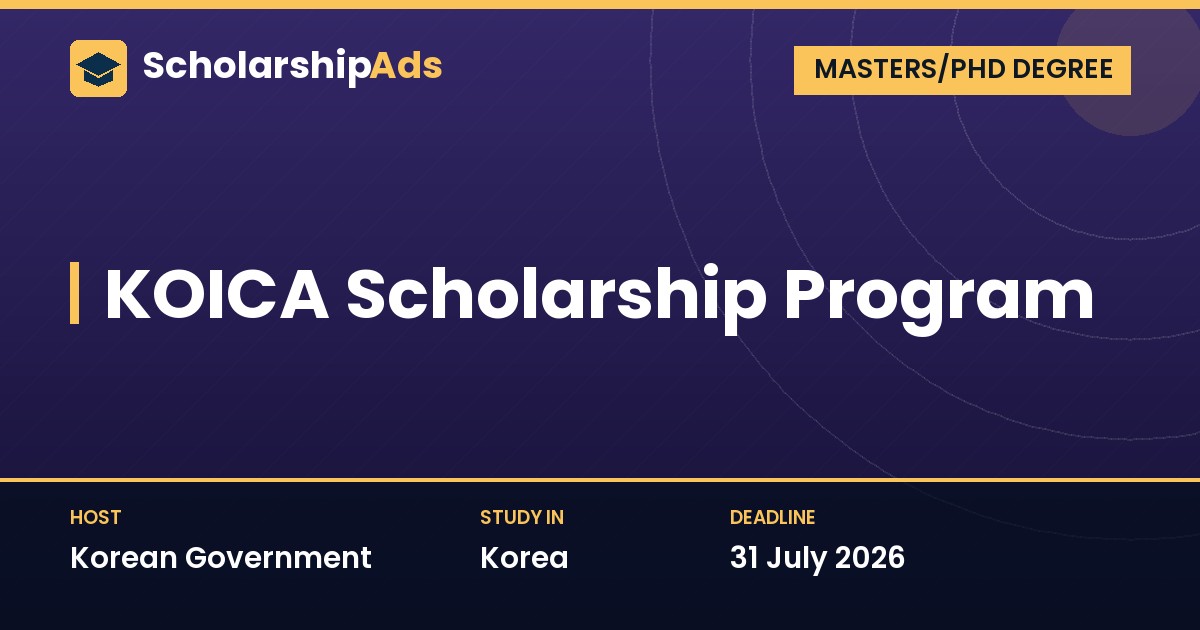
KOICA Scholarship Program 2026: Masters and PhD in Korea
Korean Government
 Fully funded
United Kingdom
Global Leadership Scholarships at University of Glasgow
Glasgow University
 New Zealand
University of Waikato International Excellence Scholarship, New Zealand
University of Waikato
 Fully funded
United Kingdom
Allan & Nesta Ferguson Charitable Trust Masters Scholarships at University of Sheffield
University of Sheffield
Who can apply for the GKS scholarship?
GKS is for international students who are not Korean citizens and who want to study in Korea. Beyond that, the rules differ by track, so read the call for your level before you do anything else.
- You must be a citizen of a country with a GKS quota for your track and hold a passport from that country
- You must meet the academic requirement for the level: a completed secondary education for undergraduate, a bachelor's degree for master's, a master's for doctoral
- You must be in good health and able to live and study in Korea for the full period
- You must not have previously received a GKS award at the same level
- You must apply through one route only: the embassy in your country or a designated university
Embassy track or university track
The embassy track runs through the Korean embassy in your country. The university track runs through a participating university that has been given places. You cannot use both in the same round, and choosing the wrong one for your profile is one of the most common reasons applications fail at the first screening.
GKS deadlines and timeline for 2026
GKS runs on an annual cycle, and the dates move a little each year. The call for 2026 is published on the official Study in Korea site, and that page is the only place where the exact dates for your country and track are fixed. Do not plan around a deadline you saw on a blog or in a forum post.
What you can do now is work backwards from the pattern. Embassies and universities usually close their internal intake a few weeks before the national deadline, because they have to screen and forward nominations. Build your document file before the call opens, not after.
| Stage | What happens | Where to check |
|---|---|---|
| Call published | Guidelines, tracks, quotas and forms released | Official Study in Korea site |
| Embassy or university intake | Local deadline, often earlier than the national one | Korean embassy or chosen university |
| First screening | Documents checked, shortlist drawn up | Embassy or university |
| Second round | Interviews and further review | Embassy or university |
| Final selection | Successful candidates and universities announced | Official site |
How to apply for the GKS scholarship, step by step
- Read the current GKS guidelines on the official site for your level and note the track, quota and forms.
- Decide between the embassy track and the university track, based on your profile and the universities you want.
- Shortlist universities and programmes from the list in the call, and check the language of instruction for each.
- Collect your documents: transcripts, degree certificates, passport, personal statement, study plan and recommendation letters.
- Get official translations and apostilles or consular legalisation where the guidelines require them.
- Write the personal statement and study plan against the programme you chose, not as generic essays.
- Submit to the embassy or university before its internal deadline, keeping a copy of everything you send.
- Prepare for the interview and check the official site for results at each stage.
Documents you need for a GKS application
The document list is long and unforgiving. Missing one form, an uncertified translation or a recommendation letter that arrives late can end your application before anyone reads your study plan. Assemble the file early and check it against the current guidelines line by line.
- Application form from the current call
- Personal statement and study plan
- Academic transcripts and degree certificates for every qualification
- Passport copy and proof of citizenship
- Recommendation letter or letters as specified
- Medical self-assessment or health form
- Certified translations and apostille or consular legalisation where required
- Any additional documents the embassy or university asks for
How GKS selection works
Selection happens in stages. The embassy or university screens documents first, then shortlists candidates for interview, then forwards nominations. The final decision is made centrally, and the university placement is confirmed at the end. Each stage can remove you, so treat the interview as seriously as the written file.
Reviewers read your study plan to see whether the programme fits your background and whether you can explain why Korea. A statement that could be sent to any country in the world reads as low effort. Name the university, the department and the specific courses that connect to what you have already done.
Who GKS suits, and who should look elsewhere
GKS suits students who want a fully funded degree in Korea and are ready to spend a year on Korean language training before it. It also suits people who can plan a year ahead, because the cycle is annual and the documents take time.
Look elsewhere if you need to start within a few months, if you cannot commit to the language year, or if you want to apply to several countries at once under one scheme. If your goal is development-related postgraduate study in Korea and you work in the public sector, the KOICA Scholarship Program is a separate route worth reading. Its current round has a deadline of 31 July 2026, and the exact date is set by the KOICA overseas office.
Common GKS mistakes to avoid
Most failed applications fail on process, not talent. These are the errors that come up again and again.
- Applying through both the embassy and a university in the same round
- Using last year's forms or guidelines
- Sending uncertified translations or missing the apostille
- Writing one generic study plan for several universities
- Missing the embassy's internal deadline because you aimed at the national one
- Ignoring the language requirement and the language year
- Leaving the medical form until the last week
Other scholarships for studying in Korea
GKS is the biggest government route, but it is not the only one. The KOICA Scholarship Program funds master's and doctoral study in Korea for public officials and publicly affiliated workers from partner countries, with tuition, a monthly allowance, airfare, accommodation, a settlement allowance, insurance and extracurricular activities covered. Its deadline is around July 2026 and the exact date is set by the KOICA overseas office.
An older KOICA round is described in the KOICA Scholarship Program for Developing Countries listing. That page is archived, so use it to understand the programme and its public-sector focus, and check the official site for the current round rather than quoting its old dates.
For other openings in the country, browse the filtered list for this page. If you are comparing destinations, our guides to scholarships in Japan and scholarships in Singapore cover the nearest alternatives, and all guides lists the rest.