
What are Canada graduate scholarships for master's study?
Canada graduate scholarships for master's study are funding awards offered by Canadian universities, provinces and government programmes to help students pay for a master's degree. They range from small entrance awards to multi-year fellowships. Most are partial, meaning they cover part of your costs rather than everything.
For international students, the key point is that eligibility rules differ by award. Some are open to all master's students regardless of nationality, while others target domestic students or specific groups. Always check the official page for the current amount and deadline.
How to read this list of master's scholarships in Canada
The live list below shows current openings for master's study in Canada. Each entry names the host, the level, the funding type and the deadline. Start by checking the level: some awards cover both master's and PhD, while others are master's only. Then check the funding type: a stipend or grant is paid to you, while tuition awards go to the university.
Use the filtered list to see only master's awards in Canada: master's scholarships in Canada. For a wider view, see Scholarships in Canada.
Open scholarships that match

 Canada
University of Winnipeg President’s Scholarships for World Leaders
University of Winnipeg
 Canada
Numerix Women in Finance Scholarship 2026 for Master's and PhD Students
FINCAD
 Canada
 Germany
Canadian International Development Scholarships 2030 (BCDI 2030): Government of Canada Funding
Canadian Government
 Canada
University of Manitoba Graduate Fellowships (UMGF) for Master's and PhD Study in Canada
University of Manitoba
 United StatesCanada
PEO International Peace Scholarships for Women: Masters and PhD Study in the US and Canada
PEO
 Canada
International Master’s Award of Excellence at the University of Waterloo
University of Waterloo
 Canada
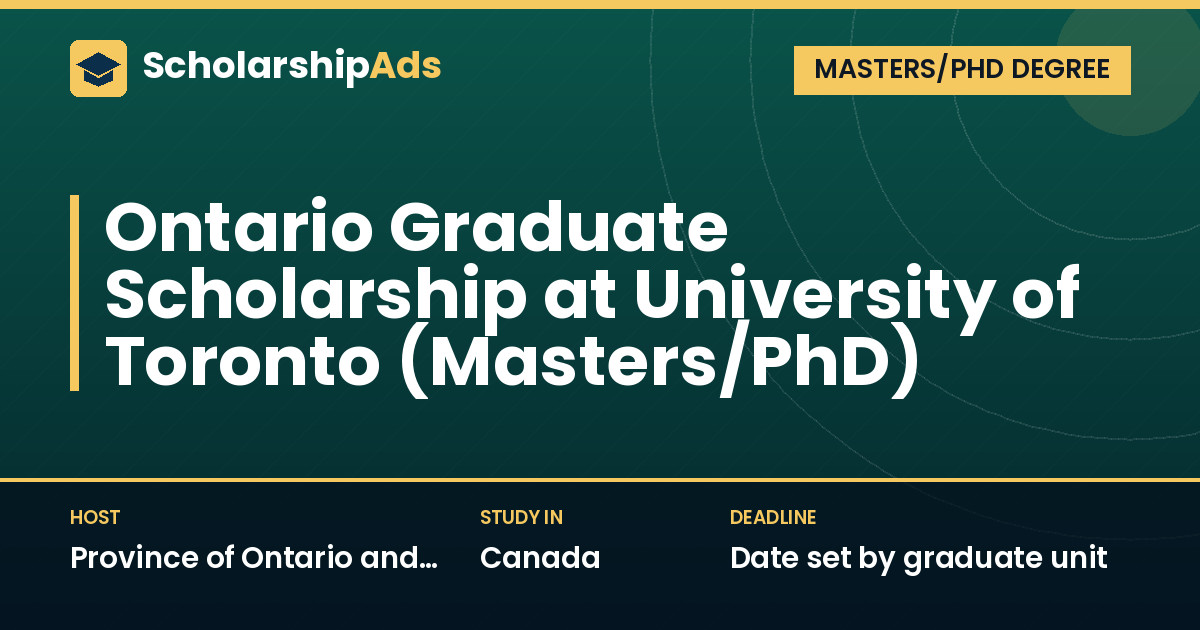
Ontario Graduate Scholarship at University of Toronto (Masters/PhD)
Province of Ontario and the University of Toronto
Real Canadian master's awards grouped by what they offer
These examples show the range of what you can find. Each links to our full listing with the official details.
University fellowships and graduate awards
- University of Manitoba Graduate Fellowships (UMGF) for Master's and PhD Study in Canada: master's awards pay $20,000 per year for 12 or 24 months, up to $40,000. Deadlines vary per faculty.
- Ontario Graduate Scholarship at University of Toronto (Masters/PhD): valued at $5,000 per session, up to $15,000 for three sessions. The graduate unit sets the deadline.
International student awards
- International Master’s Award of Excellence at the University of Waterloo: $2,500 per term for up to five terms. Deadline varies, typically January to February.
- University of Winnipeg President’s Scholarships for World Leaders: valued at $5,000. Deadline 1 June.
Government and development funding
- Canadian International Development Scholarships 2030 (BCDI 2030): Government of Canada Funding: value varies by project. Deadlines vary per project partner.
Subject-specific and women-only awards
- Numerix Women in Finance Scholarship 2026 for Master's and PhD Students: US$20,000, half paid to you and half to your institution. Deadline 6 May 2026.
- PEO International Peace Scholarships for Women: Masters and PhD Study in the US and Canada: up to $12,500 per year, renewable once. Deadline 15 December.
Comparison table: awards, levels, funding and deadlines
| Award | Level | What it pays | Deadline |
|---|---|---|---|
| UMGF | Master's/PhD | $20,000 per year for master's, up to $40,000 | Varies per faculty |
| Ontario Graduate Scholarship | Master's/PhD | $5,000 per session, up to $15,000 | Set by graduate unit |
| Waterloo IMAAE | Master's | $2,500 per term, up to 5 terms | Varies, Jan-Feb |
| Winnipeg President's | Bachelor's/Master's | $5,000 | 1 June |
| FINCAD Women in Finance | Master's/PhD | US$20,000, split between you and institution | 6 May 2026 |
| PEO International Peace | Master's/PhD | Up to $12,500 per year, renewable once | 15 December |
| BCDI 2030 | Training/Master's/PhD/Research | Varies by project | Varies per project partner |
Who qualifies for master's scholarships in Canada?
Eligibility depends on the award, but common requirements include:
- Admission to a master's programme at a Canadian university (or a partner institution for some government awards).
- International or domestic student status as specified by the award.
- Specific nationality, gender or field of study for targeted awards.
- Academic merit, financial need, or both.
- Some awards require you to be nominated by your department.
For example, the PEO International Peace Scholarships are for women only, while the Waterloo award is for international master's students. Always read the official eligibility section before you spend time on an application.
Deadlines and timeline for Canada graduate scholarships
There is no single deadline for master's scholarships in Canada. University awards often follow the admission cycle, with deadlines between December and June. Provincial awards like the Ontario Graduate Scholarship set deadlines by graduate unit. Government programmes like BCDI 2030 vary by project partner.
Plan backwards from your programme start date. If you start in September, applications for entrance awards may close in January or February. Some awards, like the Winnipeg President's Scholarships, have a June deadline. Check each listing for the exact date and whether it is annual.
How to apply for a master's scholarship in Canada: step by step
- Shortlist programmes and awards. Use the filtered list to find awards open to international master's students in your field.
- Check eligibility. Confirm nationality, level, field and whether you need a nomination.
- Note the deadline. Put it in your calendar and work back at least two months for documents.
- Prepare your documents. Transcripts, CV, motivation letter, references and proof of admission if required.
- Submit the application. Some awards require a separate form; others consider you automatically when you apply for admission.
- Follow up. Confirm receipt and check your email for requests for missing items.
Documents you will need
- Academic transcripts and degree certificates.
- Curriculum vitae or resume.
- Motivation letter or statement of purpose.
- Letters of recommendation.
- Proof of admission or application to a Canadian university.
- Language test scores if required by the university.
- Financial need documentation for need-based awards.
Requirements vary by award. The official page lists exactly what to upload.
How selection works
Selection committees usually weigh academic merit first, then fit with the award's purpose. For targeted awards, they also check whether you meet the specific criteria, such as gender or field of study. Some awards are decided by your department, which means your application may be ranked alongside other students in your programme.
Because most awards are partial, a strong application shows how the funding fits into a realistic budget. The official page explains the selection criteria for each award.
Who these scholarships suit and who should look elsewhere
Who it suits: students who have already chosen a Canadian master's programme and want to reduce costs. It also suits those who meet specific criteria, such as women in finance or international students at particular universities.
Who should look elsewhere: students who need full funding covering tuition, living costs and travel. Most Canadian master's awards are partial. If you need fully funded options, look at awards that state full funding, or consider other countries: Scholarships in United Kingdom, Scholarships in Australia, Scholarships in United States, Scholarships in Germany, Scholarships in the Netherlands.
Common mistakes to avoid
- Applying for awards you are not eligible for, such as domestic-only awards.
- Missing deadlines because you assumed they matched the admission deadline.
- Submitting a generic motivation letter that does not mention the award.
- Ignoring awards that require departmental nomination.
- Forgetting that some awards pay the institution, not you.
Alternatives if you need more funding
If the master's awards you find are too small, widen your search. Look at PhD-level awards if you are open to doctoral study, or at awards in other countries. You can also check subject-specific lists: Economics & Finance Scholarships, Engineering Scholarships, Law and Public Policy Scholarships, MBA Scholarships. For more tips, see Scholarship tips and All guides.