
How to read this list of scholarships for Filipino students
The awards below are grouped by what they actually pay, because that is the first thing that decides whether a scholarship is usable. A full award covers tuition and living costs. A tuition waiver covers fees only, so you still need money for rent and food. A monthly stipend may leave tuition to be paid separately.
Read the funding column before the deadline column. A scholarship with a generous stipend and a deadline you can meet beats a famous name you cannot fund. Use the filtered list for this page for the current round, and the scholarship finder to widen the search by country or field.
Check three things on every listing
- Whether your nationality is eligible. Several awards are reserved for developing countries, and the Philippines usually qualifies.
- Whether the award is full or partial. Partial awards are common at European universities.
- Whether you must be admitted to the university first. Many deadlines are separate from the admission deadline.
Full scholarships for Filipino students to study abroad
These awards cover tuition and living costs, or come close to it. They are the ones most Filipino applicants mean when they search for a full scholarship to study abroad.
| Programme | Level | What it covers | Deadline |
|---|---|---|---|
| Chevening Scholarships (UK) | Master's | Tuition, monthly living allowance, travel, visa cost | 6 Oct 2026 |
| Gates Cambridge Scholarships (UK) | Master's/PhD | Full cost of study, maintenance allowance, airfare, visa costs | 14 Oct 2026 for US citizens resident in the USA, and other rounds |
| Fulbright Foreign Student Program (USA) | Master's/PhD | Tuition, airfare, living stipend, health insurance, J-1 visa sponsorship | Varies, Feb-Oct 2026 |
| Australia Awards Scholarships | Bachelor's/Master's/PhD | Tuition, return air travel, living expenses contribution, health cover | 30 April 2026 |
| Justus & Louise van Effen Excellence Scholarships (Netherlands) | Master's | Full tuition plus living expenses contribution | 1 Dec 2026 |
| Maastricht NL-High Potential Scholarships | Master's | Living expenses, insurance, visa, tuition, pre-academic training | 1 February 2027, 23:59 CET |
| VLIR-UOS ICP Connect Scholarships (Belgium) | Master's | Tuition, travel, insurance, board and lodging | 1/28 Feb 2026 |
| IOE Centenary Masters Scholarships (UCL, London) | Master's | Full tuition, accommodation at International Students House, annual stipend | 4 May 2026 |
Two of these deserve a note for Filipino applicants. Chevening is a UK government scheme with a single application window each autumn, and Fulbright is run through the US embassy and country-specific pages, so the deadline you see depends on where you apply from. Always confirm on the official page.
Open scholarships that match
 Australia
La Trobe Academic Excellence Scholarships for International Students
La Trobe University
 Canada
UBC International Scholars Program for International Students
University of British Columbia
 Australia
Endeavour Postgraduate Leadership Award (Australian Government) for Masters/PhD
Australian Gov’t

 France
Fondation Rainbow Bridge MBA Scholarship at HEC Paris for African and Asian Women
Fondation Rainbow Bridge/HEC
 France
Emile Boutmy Scholarships at Sciences Po for Non-EU Students
Sciences Po
 Switzerland
ETH Zurich Excellence Masters Scholarships (ESOP)
ETH Zurich
 Australia
Dean's International Postgraduate Research Scholarship at University of Sydney Faculty of Science
University of Sydney
 Fully funded
 The Netherlands
Justus & Louise van Effen Excellence Scholarships at TU Delft for International Master's Students
Delft University of Technology
 The Netherlands
Eric Bleumink Scholarships at University of Groningen (Masters, Netherlands)
University of Groningen
 Fully funded
The Netherlands
Leiden University Excellence Scholarships (LExS) for Master's Study in the Netherlands
Leiden University
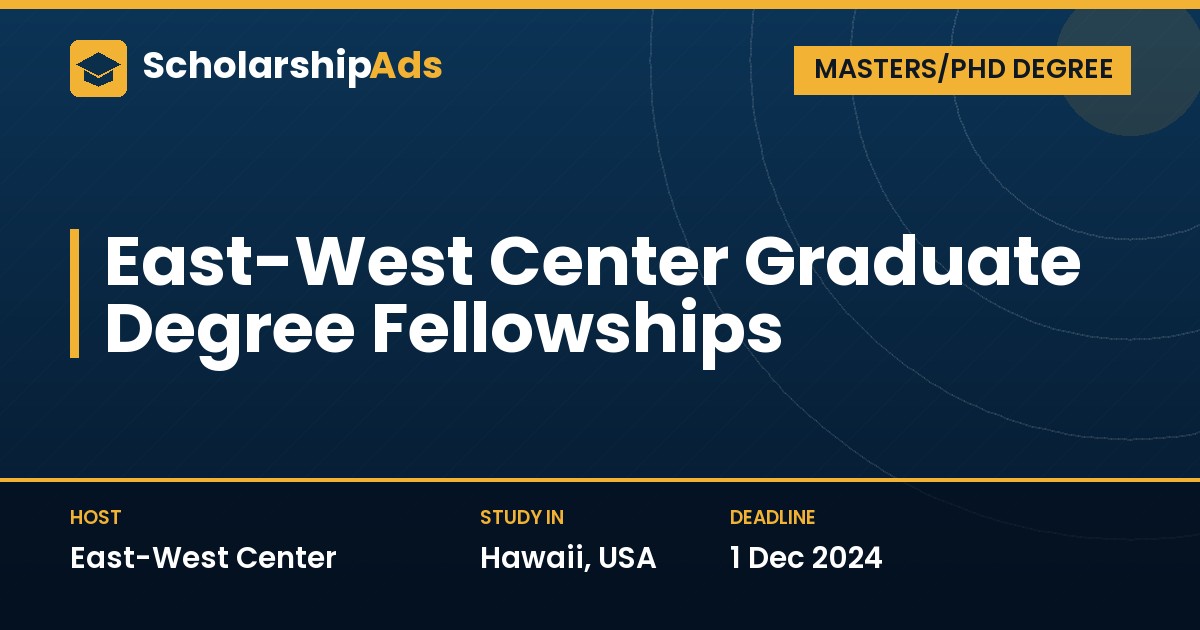
 United States
East-West Center Graduate Degree Fellowships for Asia, Pacific and US Students
East-West Center
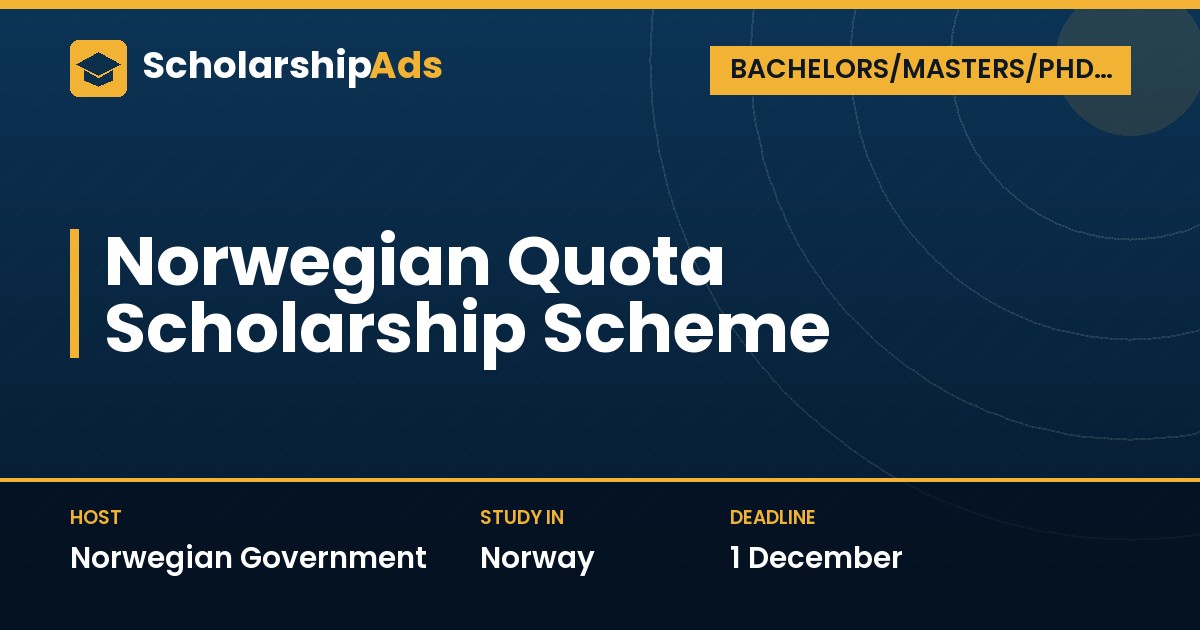
 Norway
Norwegian Quota Scholarship Scheme for Developing Countries
Norwegian Government
Tuition waivers and partial awards that still cut your costs
Not every usable scholarship pays living costs. A tuition waiver can still remove the largest single bill, especially at European universities where fees for non-EU students are high.
- KTH Scholarship (Sweden) pays tuition for the first and second year, subject to satisfactory results. It does not cover living costs. Deadline 15 January 2027.
- Axel Adler Scholarships (University of Gothenburg) is a tuition fee waiver only, with no living or travel support. Deadline 15 January 2027.
- VU Amsterdam Fellowship Programme covers tuition fees and no extra living allowance. Deadline 1 February 2027, 23:59 CET.
- Radboud Scholarship Programme cuts the tuition fee to a much lower rate and covers visa, residence permit and insurance costs. Deadline 31 January 2027, 23:59 CET.
- Ampère Excellence Scholarships (ENS de Lyon) pay a monthly grant for one academic year, renewable under conditions. Deadline 23 Jan 2026, annual.
- Italian Government Scholarships offer tuition exemption depending on each university's policy, plus health and medical insurance. Deadline 26 March 2026.
If your family can cover living costs but not tuition, this group is where to focus. If you need both, stay with the full awards above.
Research and doctoral funding for Filipino students
PhD applicants have a separate set of options, and several are explicitly for developing countries. These awards usually pay a monthly allowance and insurance rather than a salary, and they expect a research proposal at application stage.
- DAAD Development-Related Postgraduate Scholarships pay 992 euros a month for graduates or 1,300 euros for doctoral candidates, plus insurance and a travel allowance. Deadline around August to October each year.
- Swiss Government Excellence Scholarships pay CHF 2,450 a month plus insurance, a rental deposit grant and a return flight allowance. Deadlines vary, September to December 2026.
- Global Minds Doctoral Scholarships at KU Leuven cover tuition, a monthly allowance, insurance, travel and a research allowance. Deadline 4 February 2027 at 17.00 GMT.
- University of Sydney International Stipend Scholarship pays a stipend plus relocation and thesis allowance, with tuition covered through the linked fee scholarship. Deadlines 11 September 2026 and 18 in the following round.
- AAUW International Fellowships are for women and pay $20,000 at master's level and $25,000 at doctorate level. Deadline 17 Sept 2026.
Undergraduate and school-leaver awards
Fewer full awards exist at bachelor's level, so competition is tighter and the financial-need assessment matters more.
- UBC International Scholars Program (Canada) sets the award in proportion to your assessed financial need, covering tuition, fees and living costs, and it may be renewed for up to three additional years. Deadline 15 November.
- Reach Oxford Scholarships cover tuition and college fees, a living grant and one return air fare per year for three or four years. Deadlines 15 Oct 2026 and 26 Jan 2027.
- Wells Mountain Foundation Empowerment Through Education Scholarships range from $300 to $3,000 a year for undergraduate study in any developing country, usable for tuition, books, room and meals. Deadline 1 March 2026, annual.
Reach Oxford is aimed at students from developing countries who have faced financial or educational disadvantage, and it is applied for through the Oxford undergraduate process. Read the official page for the exact eligibility wording before you plan around it.
What Filipino applicants need to qualify
Eligibility differs by scheme, but the recurring requirements are consistent enough to plan around.
- Philippine nationality and, for some awards, a return commitment to the country after study.
- A completed bachelor's degree for master's awards, or a master's for PhD awards, with strong academic results.
- English proficiency through IELTS, TOEFL or a recognised equivalent, unless the university waives it.
- Admission or a pending application to the host university, since most awards are tied to a specific course.
- Work experience for some professional master's schemes, and a research proposal for doctoral funding.
- Financial documents for need-based awards such as UBC, which assesses what you and your family can contribute.
Age limits, grade averages and service bonds vary by programme. Where a listing does not state a figure, the official page holds the current rule.
How to apply for scholarships abroad, step by step
- Decide your level and field first. Bachelor's, master's and PhD have different lists, and your field narrows them further through pages such as engineering scholarships or health scholarships.
- Shortlist three to five awards in the same intake window so one set of documents serves all of them.
- Check nationality eligibility and whether the Philippines is on the accepted list.
- Apply to the university course, because most scholarships require an admission application or offer.
- Prepare your documents early, especially transcripts, translations and recommendation letters.
- Write the motivation letter for each award separately, naming the programme and what you plan to do afterwards.
- Submit before the deadline and keep the confirmation email.
- Track results and keep a backup intake in mind if the first round does not work.
Documents to prepare before the deadline
Most rejections at the document stage come from missing translations, expired test scores or a recommendation letter that arrives late. Build the file once and reuse it.
| Document | Notes |
|---|---|
| Transcripts and degree certificates | Include translations where required |
| English test score | Check the validity date against the deadline |
| Passport copy | Valid for the full study period |
| Curriculum vitae | Academic version for research awards |
| Motivation or statement of purpose | Written for each programme |
| Recommendation letters | Request them weeks ahead |
| Research proposal | For PhD and postdoc awards |
| Financial documents | For need-based awards such as UBC |
How selection works and what decides the outcome
Selection usually runs in two stages: an eligibility check on documents, then a review of academic record, fit with the programme and the case you make in your letter. Shortlisted applicants may be interviewed, in person or online.
For government schemes such as Chevening or Fulbright, the interview tests your leadership record and your plans after study. For university awards, the department's view of your academic fit carries weight. For development-related awards, reviewers look for a clear link between the degree and work you intend to do afterwards.
Where Filipino applicants can strengthen a file
- Show results with context, such as class rank or a thesis outcome.
- Name specific courses or supervisors at the host university.
- Explain the return plan in concrete terms, since many schemes fund people who will apply the training at home.
- Keep the letter to the length the form allows and answer the question asked.
Who these scholarships suit and who should look elsewhere
This list suits you if you are a Philippine national with a strong academic record, you can apply months ahead of the intake, and you are open to studying in Europe, the UK, Australia, Canada or the USA rather than one fixed country.
Look elsewhere if you need funding within weeks, since almost every award here is decided months before the course starts. It is also the wrong list if you want a scholarship for professional licensure review or a short online course, because these awards fund degree study. If you need a loan or a part-funding arrangement, a scholarship database will not solve that.
For nursing and chemical engineering specifically, the field pages are a faster route than the general list: see health scholarships and engineering scholarships. Nursing scholarships in the Philippines itself are usually offered by hospitals, universities and private foundations, and those are not covered here; check the institution's own page for current details.
Common mistakes Filipino applicants make
- Applying only to the most famous names and skipping the smaller full awards with fewer applicants.
- Missing the separate university admission deadline that sits before the scholarship deadline.
- Reusing one motivation letter across awards without naming the programme.
- Assuming a tuition waiver covers living costs. KTH and Axel Adler, for example, do not.
- Leaving recommendation letters to the last week.
- Ignoring the return or service conditions attached to government scholarships.
- Trusting a third-party summary instead of the official page for the current deadline and amount.
Other routes: country pages, field pages and alternatives
If the awards above do not fit, browse by destination. The Germany, Netherlands, United Kingdom, United States, Canada, Australia, Switzerland, Sweden, Belgium, Italy, France, Japan, Singapore and New Zealand pages each hold their own list.
Two more awards worth checking for master's study in Switzerland: the UNIL Master's Grants, which pay CHF 1,600 a month from 15 September to 15 July with a 1 November 2026 deadline, and the ETH Zurich Excellence Masters Scholarships, which combine a CHF 12,000 per semester grant with a tuition waiver and close on 30 November 2026 at 11.59h MEZ.
For public policy and governance, the DAAD Helmut-Schmidt Masters Scholarships pay 992 euros a month with no tuition fees, deadline 31 July 2026. For development training in Belgium, ARES Scholarships cover tuition, travel, subsistence, visa and insurance, deadline 18 Sept 2026. Oxford also offers the Oxford-Weidenfeld and Hoffmann Scholarship, covering fees and a living grant, and the Clarendon Fund Scholarships, covering tuition and college fees plus a living grant, both with deadlines around Dec 2026 to Jan 2027. Science applicants should look at Science@Leuven Scholarships and the University of Geneva Excellence Masters Fellowships. For more guidance on building a file, read the scholarship tips and the full guides.